The Complete Hurricane Preparation Guide for Cape Coral Homeowners
We know how quickly a tropical forecast can shift from a minor concern to an imminent threat.
Florida weather patterns demand a higher standard of preparation today.
Our crews spend the aftermath of every major event cleaning up preventable destruction.
A proactive approach makes the difference between a minor inconvenience and a total loss.
We created The Complete Hurricane Preparation Guide for Cape Coral Homeowners to share the exact strategies that actually work.
You will find actionable steps to harden your property, manage drainage, and handle insurance claims effectively.
Structural Protections
Our primary focus always begins with the building envelope.
A breach in a single window allows wind to pressurize the interior, which often leads to catastrophic roof failure.
We highly recommend establishing a reliable, impact-resistant barrier over every piece of glass.
Prices for full-home impact window installations from brands like PGT have surged recently, frequently reaching $20,000 to $25,000.
Window Protection Options
| Protection Type | Installation Cost | Pros | Cons |
|---|---|---|---|
| Accordion Shutters | $15 to $25 per sq ft | Quick deployment | Tracks require maintenance |
| Roll-Down Shutters | $25 to $45 per sq ft | Motorized convenience | Higher initial cost |
| Steel or Aluminum Panels | $7 to $15 per sq ft | Highly affordable | Labor-intensive to put up |
| 5/8-inch CDX Plywood | $2 to $5 per sq ft | Cheap DIY option | Heavy and blocks all light |
| Impact Windows | $40 to $60 per sq ft | Passive protection | Most expensive option |
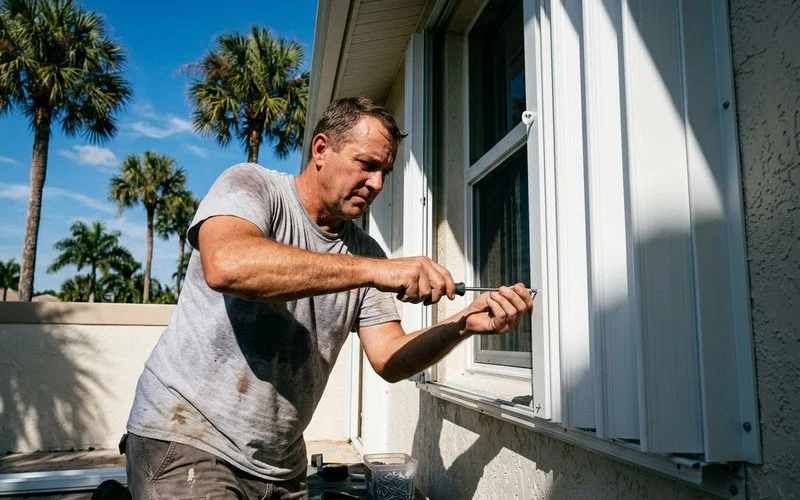
We strongly advise testing your chosen shutter system well before June.
Tracks require lubrication, and mounting hardware often corrodes in the salty coastal air.
Garage Doors and Roof Inspections
Our technicians frequently see massive structural failures starting right at the garage.
Garage doors represent the largest opening on most homes, making them highly vulnerable to intense wind pressure.
We suggest verifying your door has a proper wind rating or installing a retrofit bracing kit to secure the panels.
Have your roof professionally inspected before each hurricane season.
Address missing shingles, cracked tiles, deteriorated flashing, and any areas where water could penetrate.
A roof in solid condition is far more likely to withstand hurricane winds.
Drainage and Flood Prevention
Our approach to storm readiness treats water management as a critical priority.
Cape Coral features a unique topography with 400 miles of canals and an extensive network of roadside swales.
Swales and Right-of-Way Rules
We rely heavily on these shallow roadside ditches to move water safely away from properties.
City guidelines state that a properly functioning swale should drain completely within 12 to 24 hours after a heavy downpour.
Our local teams know that sediment buildup or improper grading usually causes standing water.
Cape Coral requires a Surface Water Management permit to re-sod the first 15 to 20 feet of your property to ensure proper water flow.
Gutters and Equipment Protection
We recommend cleaning all gutters and downspouts immediately.
Clogged gutters cause water to back up under the roof edge, which is exactly the wrong place during heavy rain.
Our inspectors always check that downspouts discharge at least 3 feet from the foundation.
Walk your property during a rain event and identify any areas where water pools near entry points.
Regrade the soil, add drainage, or install French drains to direct water away from the home.
We also urge clients to elevate outdoor AC condensers if they sit at ground level in a flood-prone area.
An AC unit destroyed by flood water costs $3,000 to $8,000 to replace in today’s market.
Yard and Exterior Preparation
Our landscaping checks focus specifically on eliminating potential flying projectiles.
High winds easily transform harmless patio items into destructive missiles that shatter glass.
Trees and Fencing
We suggest trimming trees and palms well before a storm forms in the Gulf.
Dead branches, hanging fronds, and overhanging limbs become incredibly dangerous in hurricane winds.
Our crews recommend having trees professionally trimmed and removing any dying vegetation that could fall on structures.
Repair any loose or damaged fence sections immediately.
Vinyl and wood fences are particularly vulnerable to wind.
Consider removing removable fence panels before a major storm hits to prevent them from breaking loose.
Pools and Irrigation
We constantly see homeowners make the mistake of draining their swimming pools completely before a storm.
You must leave the water in the pool, because the immense weight prevents the shell from lifting out of the ground due to rising groundwater pressure.
Our advice is to simply remove pool furniture, take out accessories, and turn off the pump at the breaker.
City regulations mandate working rain shut-off devices on all automatic irrigation systems.
We recommend turning your sprinklers off entirely during wet weeks to prevent soil oversaturation before a hurricane strikes.
Drier soil absorbs heavy rainfall much better than a flooded lawn.
Interior Preparations
Our interior hardening strategies focus on maintaining control during utility failures.
Power losses demand a clear action plan inside the house for every adult.
Utilities and Documentation
We verify that every family member knows where to find the main water shutoff valve.
You should also locate the electrical breaker panel, the gas shutoff, and individual appliance valves.
Our document protection plan involves placing insurance policies, property deeds, and medical records in a fireproof safe.
Create digital backups using secure cloud services like Google Drive or Apple iCloud.
We advise taking detailed photos and videos of every room, including closets, cabinets, and storage areas.
This pre-storm documentation provides vital, verifiable proof for insurance claims if your belongings sustain damage.
Emergency Supplies
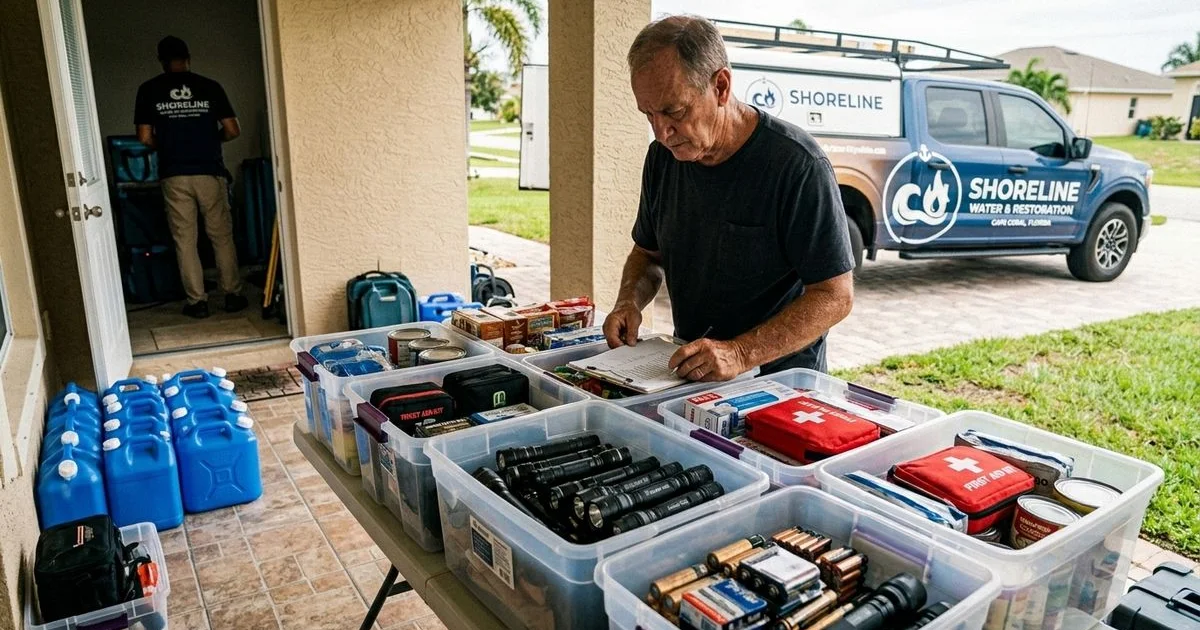
Our emergency kits account for a minimum of 72 hours of complete utility loss.
The local grid is much stronger today, but you must still prepare for extended outages.
We closely monitored Lee County Electric Cooperative (LCEC) as they upgraded the grid after Hurricane Ian.
They replaced over 2,000 transformers and 60,000 power splices, which helped restore power to 68,000 customers within 24 hours during Hurricane Milton.
Essential Kit Items
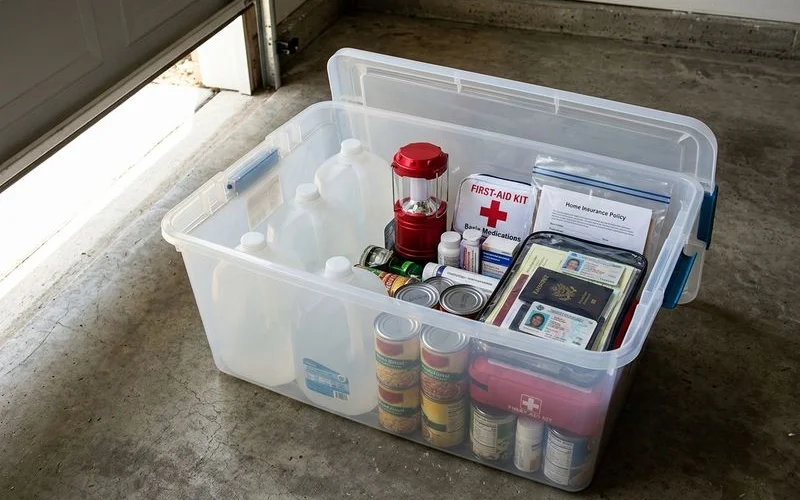
Our recommended survival cache includes the following necessities:
- Water: 1 gallon per person per day (minimum 3-day supply)
- Non-perishable food and a manual can opener
- Medications (a 14-day supply is highly recommended)
- Flashlights and extra batteries
- Battery-powered or hand-crank radio
- First aid kit
We also stress keeping a physical stash of cash on hand.
ATMs and credit card machines simply do not function when the network goes down.
Our final prep involves keeping a full tank of gas in your vehicle.
Secure several portable battery packs for your phone, and place your most critical documents in a sealed waterproof bag.
Insurance Review
Our final administrative task is a thorough policy check before the season starts.
Review your coverage early, not after the damage actually occurs.
Policy Deductibles and Flood Maps
We ensure our own dwelling coverage reflects current rebuilding costs, as construction materials have increased in price.
Florida law requires insurers to offer hurricane deductibles based on a percentage of your total dwelling coverage.
Our clients often carry deductibles ranging from 2% to 10%.
If your home is insured for $300,000 and you have a standard 2% hurricane deductible, you are responsible for the first $6,000 of damage out of pocket.
We highly advise reviewing your flood maps regularly.
Verify you have active flood insurance through the NFIP, especially if you sit near a canal or in a lower-elevation zone impacted by FEMA’s Risk Rating 2.0.
Keep your agent’s direct contact information and your policy number printed out inside your emergency kit.
Emergency Contacts
Our team keeps a physical list of these critical numbers accessible at all times.
You should program these into your phone and write them down on a notepad.
Local Government and Utilities
- Lee County Emergency Management: (239) 533-0622
- Cape Coral Police (non-emergency): (239) 574-3223
- LCEC (Lee County Electric): (239) 656-2300
- Cape Coral Utilities: (239) 574-0811
Insurance and Recovery Resources
- Shoreline Water & Restoration: (239) 268-8546
- Insurance company: (keep your agent’s direct number)
- FEMA: (800) 621-3362
When a Storm Approaches
We initiate our final lockdown procedures the moment a hurricane watch is issued for the county.
This watch means hurricane conditions are possible within the next 48 hours, leaving just enough time to finish your preparations.
When that alert hits, take the following steps immediately:
- Install shutters or plywood on all windows and glass doors
- Bring in all outdoor patio furniture and loose items
- Fill bathtubs with water to use for flushing toilets if municipal pressure drops
- Charge all devices fully and fuel your vehicle
- Review your specific Cape Coral evacuation zone (Zones A, B, C, or D)
- Consider shutting off the main water supply if you decide to evacuate
Our priority is keeping your property safe and dry.
Call (239) 268-8546 for pre-storm board-up or post-storm emergency restoration in Cape Coral.
Available before, during, and after every storm.
Conclusion
We know that preparation is the ultimate defense against unpredictable weather.
The Complete Hurricane Preparation Guide for Cape Coral Homeowners provides the blueprint, but action is up to you.
Our team stands ready to assist if the worst happens, but taking these steps now ensures your property has a fighting chance.
Start checking those window tracks, review your insurance policies, and build that supply kit today.

Gary Stone
Regional Franchise Operator
Gary Stone co-operates the Shoreline Water & Restoration Cape Coral franchise, specializing in commercial restoration and hurricane damage recovery.
Need Emergency Restoration?
Shoreline Water & Restoration provides 60-minute emergency response in Cape Coral.
Call (239) 268-8546