Cape Coral Hurricane Damage Recovery Checklist: First 72 Hours
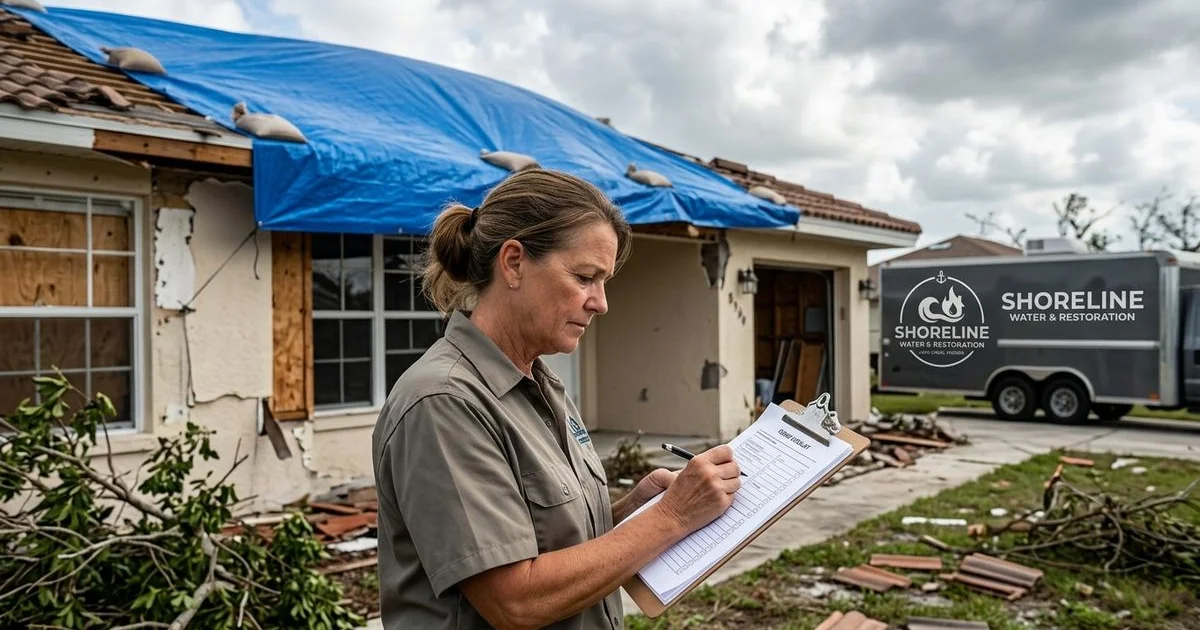
We know that the immediate aftermath of a severe storm leaves property owners scrambling for clear direction.
The hours and days after a hurricane hits Cape Coral are chaotic and stressful. Our team has guided countless residents through this critical window, where fast decisions prevent thousands of dollars in secondary damage.
Immediate mitigation and clear documentation are the two most critical factors in securing a full insurance payout after a storm.
Roads may be impassable, power may be out, cell service may be spotty, and your home may be damaged. We designed this Cape Coral Hurricane Damage Recovery Checklist: First 72 Hours to bridge the gap between panic and organized action.
Having a clear plan prevents costly mistakes and ensures you protect both your property and your insurance claim. Let’s outline the precise timeline of actions you need to take, starting from the moment the storm passes.
Cape Coral Hurricane Damage Recovery Checklist: First 72 Hours for Safety
Do not return home until authorities clear the area. Cape Coral emergency management will issue re-entry guidance. Returning too early puts you at risk from downed power lines, flooded roads, structural collapses, and gas leaks.
Our experience shows that Cape Coral emergency checkpoints often require a 48-hour safety delay depending on the storm’s severity. You will need a valid government ID and a local utility bill to prove residency before passing these checkpoints.
Approaching Your Property
When you can safely approach your property, proceed with extreme caution.
- Look for structural damage from a distance before entering, checking for sagging rooflines, leaning walls, or cracked foundations.
- Check for downed power lines on or near the property, and stay at least 30 feet away from any downed line.
- Smell for gas.
- If you detect a gas odor, leave immediately and call the fire department.
- Check for standing water, and do not walk through flood water, which may conceal debris, open manholes, or carry electrical current from submerged wiring.
Entering the Structure Safely
If the structure appears safe to enter, take preventive measures immediately.
- Turn off the main electrical breaker if any portion of the home has been flooded.
- Turn off the main water supply as a precaution against hidden pipe damage.
- Wear closed-toe shoes and thick work gloves, since broken glass, nails, and debris are common hazards.
- Take a flashlight, because interior spaces may be dark with power out and windows boarded.
Hours 6-24: Document and Protect
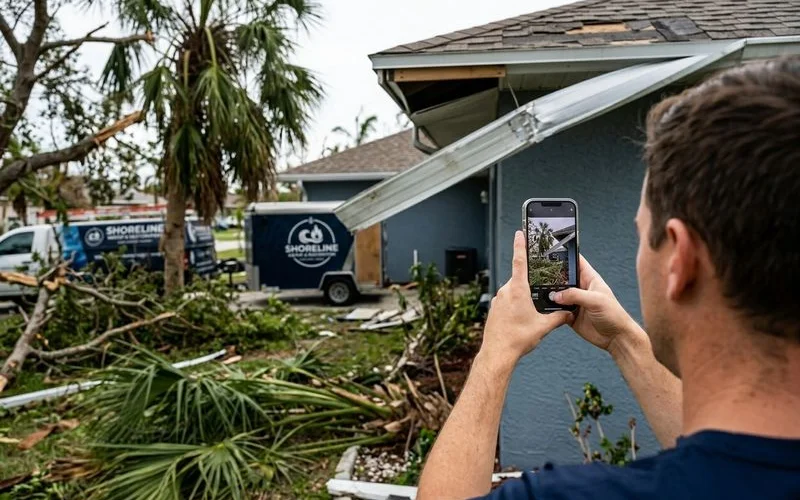
Document everything before touching anything. We emphasize this step because detailed visual proof is the foundation of a successful insurance payout. Adjusters rely heavily on these early photos.
- Photograph and video all damage from multiple angles.
- Document the exterior by capturing roof damage, siding damage, window failures, fence and landscape damage, and pool enclosure damage.
- Document the interior by filming water on floors, water marks on walls, ceiling damage, and damaged furniture.
- Photograph the attic from below to check for roof penetrations and water intrusion if the area is safe.
Prevent Further Damage
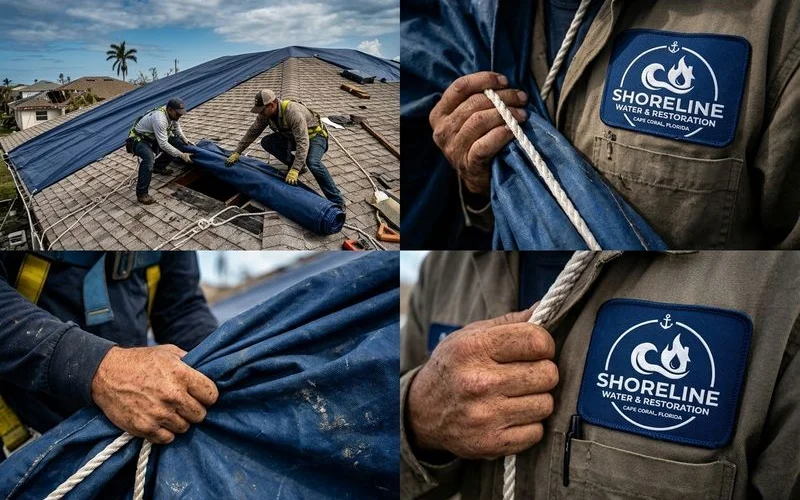
Your insurance policy includes a duty to mitigate, meaning you must take reasonable steps to prevent additional damage. Our specialists advise clients to use heavy 10-mil plastic sheeting or 5/8-inch plywood for covering openings instead of standard trash bags. Failing to secure the property can result in denied claims for subsequent water damage.
- Cover roof openings with tarps if you can safely access the roof, or call for emergency tarping if you cannot.
- Cover broken windows with plywood, plastic sheeting, or heavy-duty tape.
- Remove standing water from interior floors using any available method like mops, towels, or buckets.
- Move undamaged furniture and valuables away from water-damaged areas.
Notify Restoration and Insurance Teams
Emergency board-up and tarping, water extraction, and initial mitigation should begin as soon as conditions allow. Call Shoreline Water & Restoration at (239) 268-8546 for 24/7 emergency dispatch.
Our experts recommend reporting the claim immediately, as Florida Statute 627.70132 now strictly limits the initial claim filing window to just one year from the date of loss. Note your claim number, adjuster name, and any reference numbers. Many insurers set up local catastrophe response centers after major hurricanes, so ask about expedited processing.
Days 1-3: Stabilize and Start Recovery
Continue Water Mitigation
If professional help has arrived, they will handle extraction and drying. If not yet, you must take immediate action. Our crews see mold begin growing on saturated Florida drywall in just 24 to 48 hours. Preventing this rapid fungal growth saves substantial reconstruction costs.
- Keep removing water from the interior.
- Open windows and doors for ventilation if the weather is clear.
- Run industrial dehumidifiers and fans if power is available.
- Remove wet carpet padding, saturated cardboard, and ruined food from the home.
Compile Damage Lists and Secure Documents
Create a detailed written inventory of all damaged items. Include a description of the item, approximate age, original cost, previous condition, and current condition. This inventory is critical for your insurance contents claim. The more detailed your documentation is, the smoother the claims process becomes.
We find that freezing wet documents in zip-lock bags stops deterioration. This freezing method preserves vital photos and records until professional document restoration is possible later.
Practice Generator Safety
Generator-related carbon monoxide deaths are tragically common after hurricanes. We urge property owners to only purchase models with UL 2201 certification, which feature automatic carbon monoxide shutoff sensors. Never run a generator inside your home, garage, or any enclosed space.
Position generators at least 20 feet from windows and doors with the exhaust directed away from the house. Cape Coral noise ordinances also require residential generators to be shielded by a barrier between 6:00 p.m. and 7:00 a.m. if they exceed 60 decibels.
Common Post-Hurricane Mistakes to Avoid
Do not throw away damaged items before documenting them. Insurance adjusters need to see damaged property or at minimum need detailed photographs and descriptions.
Our team strongly advises against making permanent repairs before the adjuster inspects the site. Emergency mitigation like tarping, board-ups, and water extraction is expected and covered. Permanent repairs like replacing the roof or installing new flooring should wait until the adjuster has assessed the damage and agreed on the scope.
Guard Against Scams and Secondary Damage
Do not sign contracts with storm chasers. After hurricanes, out-of-town contractors flood the area soliciting repair work. Many are uninsured, unlicensed, and will take deposits before disappearing. Work with established local companies with verifiable licenses and references.
We warn residents not to ignore mold prevention or their HVAC systems. Start drying efforts immediately, even if you cannot get professional help right away.
If flood water entered your outdoor AC unit or indoor air handler, do not turn on the system until an EPA-certified technician inspects it. Running a flood-damaged HVAC system can cause electrical failure and spread contaminants through ductwork.
Insurance Tips for Hurricane Claims
Filing your claim early is essential since adjusters process them in the order received. Our recent data shows that filing within the first 48 hours can accelerate your inspection timeline significantly.
Keep all receipts for emergency expenses like hotels, meals, temporary repairs, tarps, and generators. Your insurance may have separate deductibles for hurricane damage versus standard damage, so check your policy specifics.
Florida Insurance Claim Deadlines Comparison
Missing a deadline permanently bars your right to file a claim. Our team tracks these statutory requirements closely to protect client payouts. Keep these critical 2026 timeframes in mind.
| Claim Action | Statutory Deadline | Key Requirement |
|---|---|---|
| Initial Hurricane Claim | 1 Year from Date of Loss | Must report all known damage to the insurer. |
| Supplemental Claim | 18 Months from Date of Loss | Covers hidden damage discovered during repairs. |
| Insurer Acknowledgment | 14 Days from Filing | Company must acknowledge receipt of the claim. |
| Payment Decision | 90 Days from Filing | Insurer must issue payment or a formal denial. |
Understanding Coverage Rules
Flood damage from rising water requires a separate National Flood Insurance Program policy because standard homeowner policies do not cover it. We always tell clients to review their first settlement offer carefully against the documented damage list.
Florida law requires insurance companies to acknowledge your claim within 14 days and make a payment decision within 90 days. If you discover hidden damage later, you have 18 months from the loss date to file a supplemental claim.
Recovery Resources
Securing disaster recovery funding requires access to the right municipal tools. Our local knowledge directs homeowners to these essential lifelines. FEMA provides a Serious Needs Assistance payment of $790 for immediate supplies, and their housing repair limit for 2026 reaches up to $43,600. Reach out to these key contacts for specific support.
- Lee County Emergency Management: (239) 533-0622
- FEMA Disaster Assistance: (800) 621-3362 or DisasterAssistance.gov
- Cape Coral Utilities (water/sewer issues): (239) 574-0811
- Shoreline Water & Restoration: (239) 268-8546
Taking rapid action after a storm protects your family and secures your financial recovery. Our checklist provides a solid foundation for those crucial early days.
Keep this Cape Coral Hurricane Damage Recovery Checklist: First 72 Hours handy to guide your next steps.
Call (239) 268-8546 for hurricane damage recovery in Cape Coral. Emergency board-up, water extraction, and full restoration available 24/7.

Paul Breehne
Regional Franchise Operator
Paul Breehne is a Regional Franchise Operator for Shoreline Water & Restoration in Southwest Florida, bringing over a decade of hands-on restoration experience to the Cape Coral market.
Need Emergency Restoration?
Shoreline Water & Restoration provides 60-minute emergency response in Cape Coral.
Call (239) 268-8546